If you're having trouble viewing this email, you cansee it online.
Founded in 1979, the Louisiana Trust for Historic Preservation advocates, promotes, & preserves historic places representing our diverse culture.
July 2026
Get Involved in the Great Flood Project!
Please reach out to 1927flood@lthp.org for more information and/or to share how you plan to commemorate the Centennial.
Plan and/or create a project, event, program, exhibit, etc.:
Let us know how you are commemorating the Centennial of the Great Flood so that we can map your efforts on the Website's archive and calendar! The calendar will publicly document the efforts of communities, organizations, and individuals and will allow others to know what events, etc. are happening andwhere they are taking place.
Share stories, photos, etc. from your family and/or community with the archive:
Do you have photos, letters, or other artifacts you would like to share with the project? We will include these on our interactive map.
Be Part of the Commemorative Trail by Investing in and Installing a Great Flood marker:
One of the goals of the Great Flood Project is to create a commemorative trail throughout the Mississippi River Valley, connecting communities across states that were historically impacted by the disaster and preserving the history on the physical landscape.
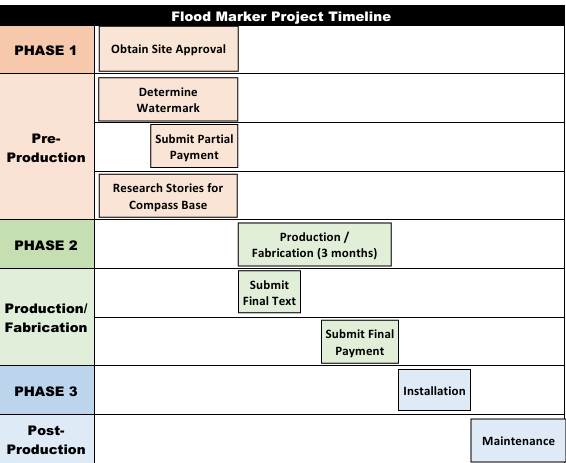
The timeline for production and fabrication to installation of a historical marker is approximately 3 months. See approximate timeline below:
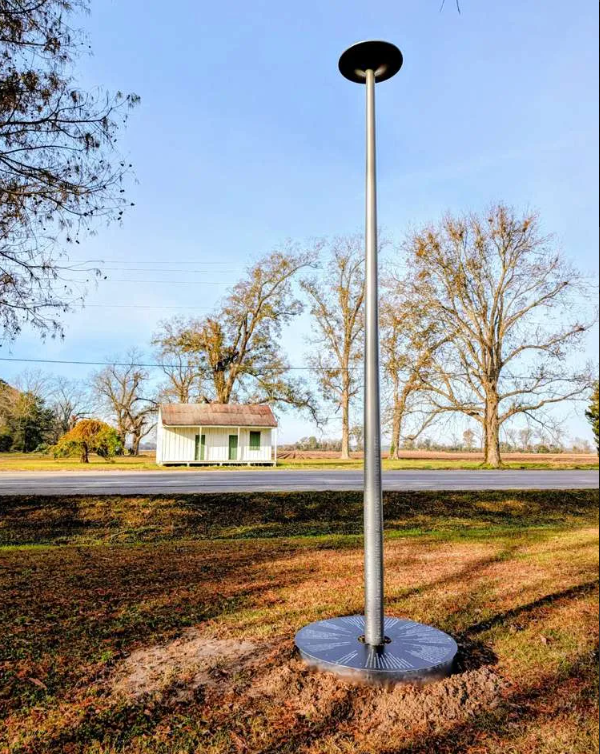
Above: Photo of inaugural Great Flood marker in New Roads, Louisiana
In July 1927: The Red Cross Headquarters Based in New Orleans Closes
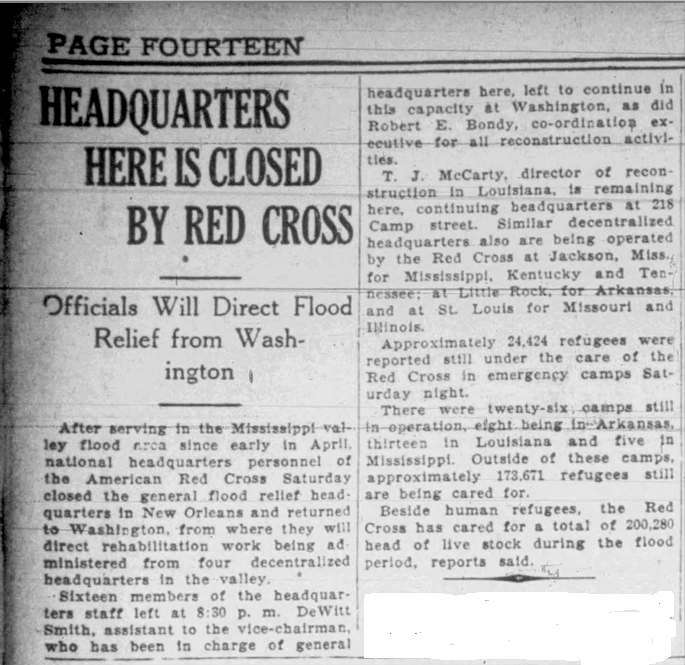
On July 10, 1927, the Times-Picayune reported that the region's general flood relief headquarters in New Orleans closed. Decentralized operations were to continue at the following: the Red Cross in New Orleans for Louisiana; in Jackson, Mississippi, for the states of Mississippi, Kentucky, and Tennessee; in Little Rock for Arkansas; and in St. Louis for Missouri and Illinois. Over twenty thousand people remained in Red Cross camps; there were reportedly twenty-six camps still in operation, with thirteen camps in Louisiana, eight in Arkansas, and five in Mississippi. [1]
[1] "Headquarters Here is Closed by Red Cross," The Times-Picayune (New Orleans, Louisiana), July 10, 1927, p. 14. (Photo from Newspapers.com)
Site Spotlight: Avoyelles Parish and Red Cross Camps
According to Crevasse!: The 1927 Flood in Acadiana, the Red Cross established Acadiana's first two refugee camps in Marksville and Mansura. As a response to the levee breaks along the Bayou des Glaises, many people were evacuated to these camps. Residents of Mansura and Marksville also took in refugees who were fleeing the floodwaters, especially while the camps were being established.
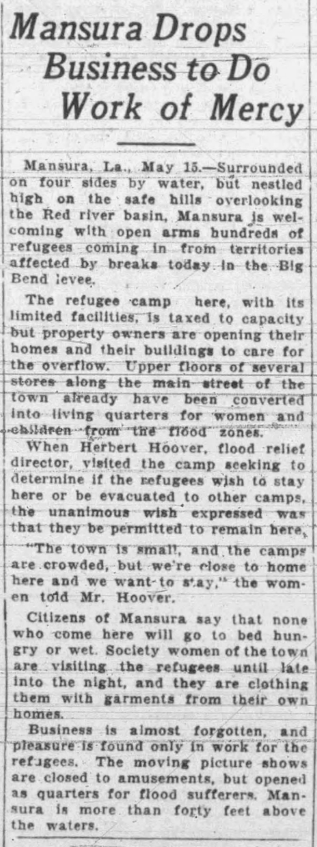
In Mansura, the Red Cross used the local theater, town hall, and bank for accommodations. By the end of May, the Red Cross had registered close to 4,000 people in the camp. [1] At one point, Secretary of Commerce Herbert Hoover visited the camp to determine whether or not it would be necessary to evacuate the camp due to capacity. The Times-Picayune reported that the refugees told him they wished to remain in Mansura, close to home. [2]
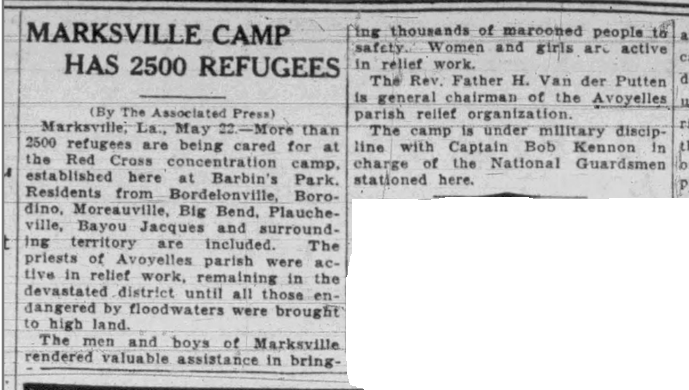
Meanwhile, in Marksville, a camp was established in the town's ballpark. One newspaper noted that the park's trees offered "lovely shade." [3] According to the paper, two "new halls" were built that "were screened and electrically lighted." They were also segregated by race. [4] The community was very involved in relief work, and the parish's priests reportedly remained in the "devastated district" until people were brought to safety. [5]
These camps quickly became overcrowded, and an "undetermined but small number of refugees" and their livestock were sent to the small town of Bunkie. [6] Eventually, many refugees were taken to the camp near Alexandria, which was built to accommodate a large population of people. [7]
Above: "Mansura Drops Business to Do Work of Mercy," The Times-Picayune (New Orleans, Louisiana), May 16, 1927, p. 3. (Newspapers.com)
Above: "Marksville Camp Has 2500 Refugees," The Times-Picayune (New Orleans, Louisiana), May 23, 1927, p. 10. (Newspapers.com)
[1] Glenn R. Conrad and Carl A. Brasseaux, Crevasse!: The 1927 Flood in Acadiana (Center for Louisiana Studies: Lafayette, LA, 1994), 46.
[2] "Mansura Drops Business to Do Work of Mercy," The Times-Picayune (New Orleans, Louisiana), May 16, 1927, p. 3.
[3] "Several Hundred Flood Refugees at Marksville Camp," The Town Talk (Alexandria, Louisiana), May 17, 1927, p. 5.
[4] Ibid.
[5] "Marksville Camp Has 2500 Refugees," The Times-Picayune (New Orleans, Louisiana), May 23, 1927, p. 10.
[6] Conrad and Brasseaux, Crevasse!, 46-47.
[7] Ibid., 47.
From the Community Archives: Photos of the 1927 Flood in Morgan City, Louisiana (St. Mary Parish)
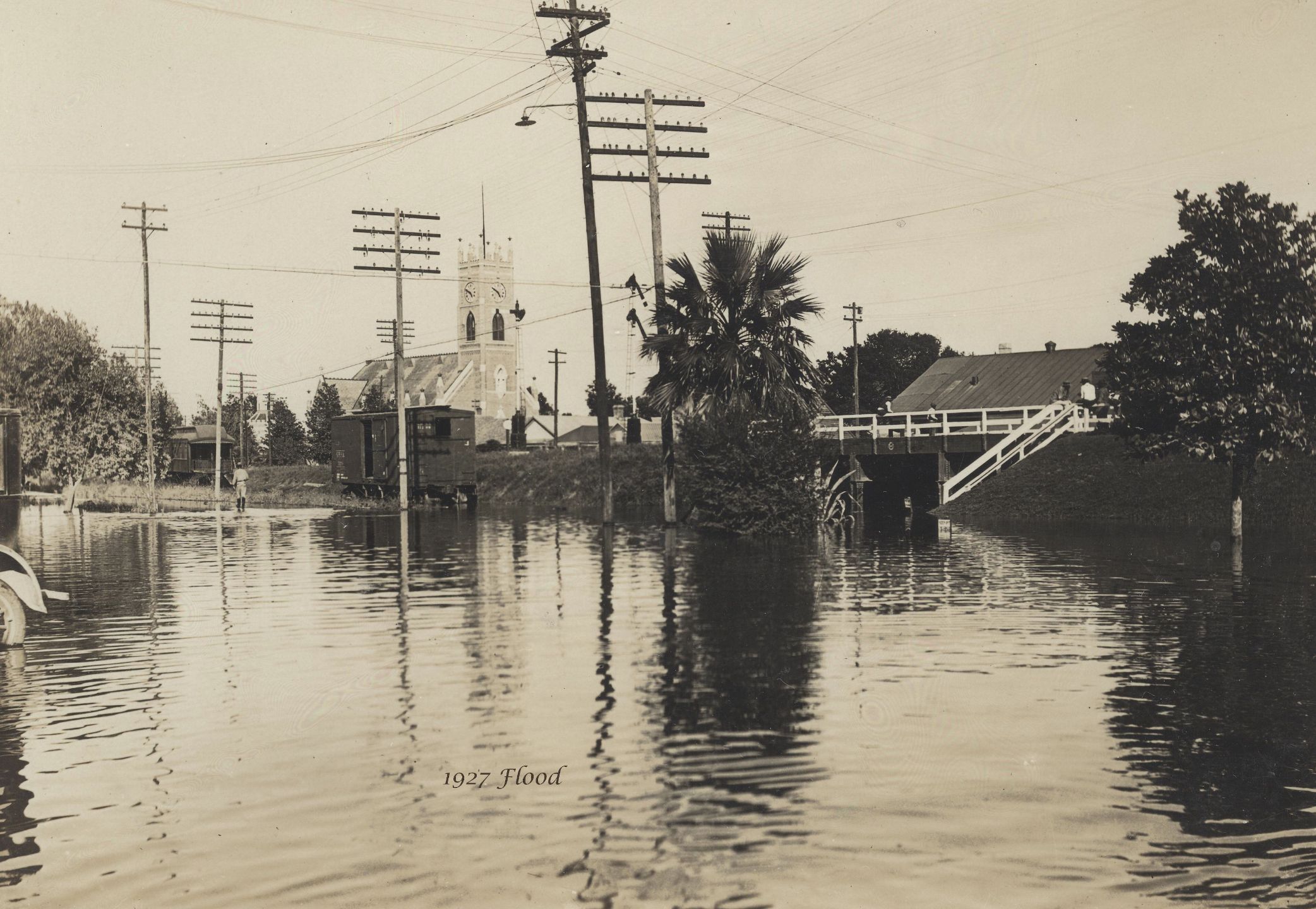
Pictured above is a photo of Morgan City, Louisiana, during the 1927 flood. This photo is part of the Morgan City Archive Collection, which can be viewed on the Great Flood Website's interactive map here.
If your archive and/or institution has photos, collections, exhibits, etc. that you wish for us to share or highlight, please reach out to 1927flood@lthp.org.