If you're having trouble viewing this email, you cansee it online.
Founded in 1979, the Louisiana Trust for Historic Preservation advocates, promotes, & preserves historic places representing our diverse culture.
June 2026
Project Updates
June events:
The Great Flood Project enjoyed attending and presenting at the Mississippi Heritage Trust conference in Brookhaven, Mississippi (June 3-5).
Potential Funding Opportunity:
Are you planning or wishing to commemorate the Great Flood Centennial through a cultural event/festival, an educational program, or the arts? Consider applying for a 2026-2027 Community Partnership Grant with The New Orleans Jazz & Heritage Foundation to support your efforts. Explore current opportunities and learn about eligibility guidelines here. Applications are due July 8th. Please contact the New Orleans Jazz & Heritage Foundation directly with questions about the grant. You may reach out to 1927flood@lthp.org or kmccullum@lthp.org with questions about the Great Flood Centennial.
Note about the timeline for historical markers:
One of the goals of the Great Flood Project is to create a commemorative trail throughout the Mississippi River Valley, connecting communities across states who were historically impacted by the disaster and preserving the history on the physical landscape.
The timeline for production and fabrication to installation of a historical marker is approximately 3 months. If your community or organization is interested in purchasing and installing a marker by Fall/Winter 2026 or Spring/Summer 2027, please reach out to kmccullum@lthp.org as soon as possible to learn more about how to get the process started. See approximate timeline below:
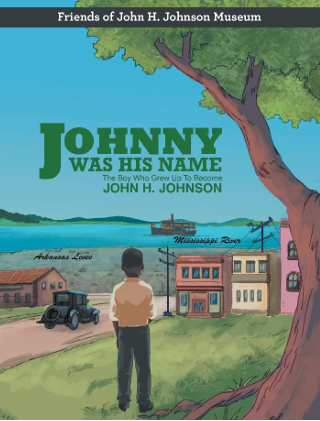
Book Spotlight: Johnny Was His Name: The Boy Who Grew Up to Become John H. Johnson
Johnny Was His Name: The Boy Who Grew Up to Become John H. Johnson tells the story of Johnny, who, at nine years old, survived the 1927 flood, seeking refuge with his mother on top of the levee in Arkansas City, Arkansas. He grew up to become the founder and publisher of Johnson Publishing Company and Ebony and Jet magazines. Learn more about the children's book (including available lesson plans) and the Friends of John H. Johnson Museum here.
The Music Issue
The 1927 Flood Depicted in Songs from the Blues to Rock n' Roll
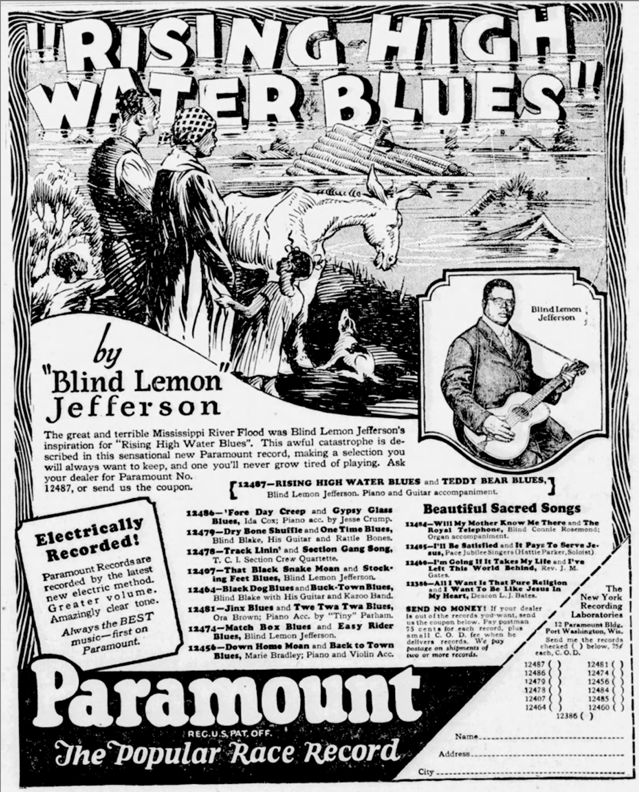
Above: The Chicago Defender (Chicago, Illinois), July 2, 1927, p. 7. (Newspapers.com)
The June issue of the Great Flood newsletter is focusing specifically on the impact of the 1927 flood on music across genres, from the historical moment that was the disaster to the more recent past. Previous newsletters have highlighted the relationship between environmental disaster and the blues, and the ways in which the latter served as a historical document and archive that documented and preserved the history of the 1927 flood, particularly through the lived experiences of Black Americans. [1]
In February 1927, before major levee breaches would devastate the lower Mississippi River Valley, blues musician Bessie Smith recorded “Back-Water Blues” which became what historian David Evans called “the flood blues” [2] and inspired several covers by other musicians through the 1930s and beyond. [3] Evans determined that the song was originally about the December 1926 flooding of the Cumberland River in Nashville, Tennessee. [4] The song was recorded just prior to the levee breaks that became known and remembered as the 1927 flood; however, it was connected to the larger event of the persistent and consistent rain that began in late summer of 1926 that caused the Mississippi River and its tributaries to swell, eventually crushing more than 120 levees. [5]
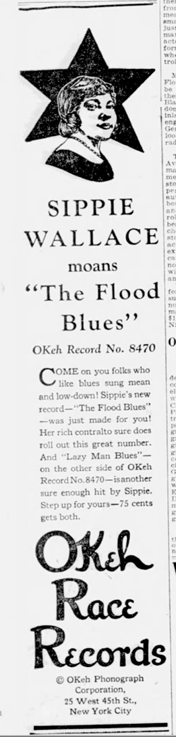
Smith recorded the song in New York City for Columbia Records, one of several companies that promoted “race records” to white audiences; they also advertised the records in Black newspapers such as the Chicago Defender and the Afro-American (Baltimore). [6] Throughout the spring and summer, these advertisements promoted various blues songs about the flood, including Blind Lemon Jefferson’s “Rising High Water Blues” and Sippie Wallace’s “The Flood Blues” (both advertisements are included in this newsletter). Lonnie Johnson recorded “South Bound Water” following the levee break near Greenville, Mississippi, and Alice Pearson recorded “Greenville Levee Blues” and “Water Bound Blues” that summer. [7] Meanwhile, country music artist Vernon Dalhart recorded “The Mississippi Flood” on April 27, shortly after the Mounds Landing crevasse.[8]
These blues songs about the flood inspired and/or were covered by other genres as well. In 1971, Led Zeppelin covered “When the Levee Breaks,” a song originally written and recorded by Kansas Joe McCoy and Memphis Minnie in June 1929 for Columbia Records. In 2001, Bob Dylan released “High Water (for Charley Patton)” on the album Love and Theft, which went on to win a Grammy award. [9] The song pays tribute to blues singer Charley Patton, who recorded the two-part “High Water Everywhere” (1929) as a response to the 1927 flood.
Another song written and released years after the disaster is Randy Newman’s “Louisiana 1927,” which appeared on his 1974 album Good Old Boys. The chorus sings “They’re trying to wash us away,” and the lyrics reference the flooding of Plaquemine Parish as well as “six feet of water in the streets of Evangeline.” The song reemerged in national consciousness after Aaron Neville performed it on NBC for a relief concert in the wake of Hurricane Katrina; it was also featured on an episode of HBO’s Treme.
These are just a few examples of songs that emerged from the Great Flood that continue to teach about its history today. Please see below for further reading and listening recommendations. These resources contain audio of many of the songs mentioned here.
[1] See in particular Richard M. Mizelle, Backwater Blues: The Mississippi Flood of 1927 in the African American Imagination (University of Minnesota Press, 2014).
[2] David Evans, "Bessie Smith's 'Back-Water Blues': the story behind the song," Popular Music 26, no. 1 (2007): 99.
[3] Susan Scott Parrish, The Flood Year 1927: a Cultural History (Princeton University Press, 2017).
[4] See Parrish, The Flood Year 1927; and Evans, "Bessie Smith's 'Back-Water Blues.'"
Above: The Chicago Defender (Chicago, Illinois), July 2, 1927, p. 7. (Newspapers.com)
Exploring the Mississippi Blues Trail:
Sites connected to the Flood Blues
Speaking of the flood blues, there are several historical markers along the Mississippi Blues Trail that are connected to the history of the 1927 flood, either through the location itself or through the musician who sang about (and documented) the event. Previous newsletters have gone into larger detail about these histories, but below you can find various markers (this is not an exhaustive list) to visit:
WNYC Studios Soundcheck Podcast talks to Filmmaker Bill Morrison about The Great Flood Documentary
In January 2014, the WNYC Studios Soundcheck podcast conducted an interview with documentary filmmaker Bill Morrison about his film titled The Great Flood (2013) and the impact that the 1927 flood had on music. The Great Flood is a silent film with an original soundtrack by guitarist and composer Bill Frisell. The podcast discusses and plays parts of twelve songs that document this devastating and transformative moment in American history. Listen and learn more here.