If you're having trouble viewing this email, you cansee it online.
Founded in 1979, the Louisiana Trust for Historic Preservation advocates, promotes, & preserves historic places representing our diverse culture.
May 2026
Project Updates
The month of May included travel to the Tensas Parish Public Library in St. Joseph, Louisiana, as well as to Lafayette and St. Martin Parishes to discuss potential sites for Great Flood historical markers.
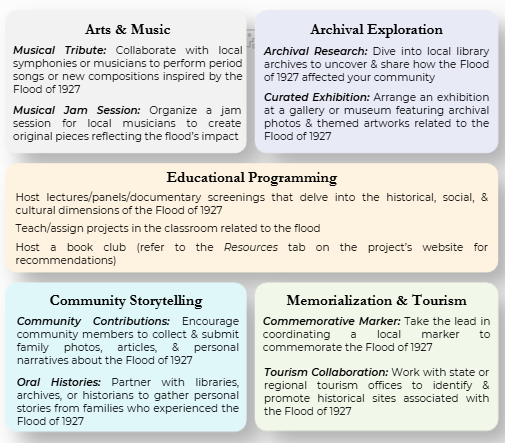
On May 11, theLouisiana Trust for Historic Preservationand theLouisiana Division of the Artshosted a Zoom discussion about the Great Flood Centennial and Louisiana Project Grants, where we provided an overview of both the Great Flood Project and Louisiana Project Grants, as well as how to participate in the Centennial via an arts project. Learn morehere.The guidelines and grant application for Louisiana Project Grants can be foundhere.The application closes onFriday, June 12.
The Great Flood Project will continue to post information on its Website about potential funding opportunities that may support larger events, projects, etc. as part of participation in the Centennial. However, keep in mind that you may participate in the Centennial on any scale!
Please reach out to kmccullum@lthp.org if you wish to discuss participating in the Great Flood Project! And be sure to follow the LTHP onFacebookandInstagramto stay updated on news, events, and stories throughout the month in between issues of the newsletter.
The 1927 Flood and St. Joseph, Louisiana (Tensas Parish)
Tensas Parish (which borders the Mississippi River) and other parts of northeastern Louisiana were historically susceptible to flooding before the Flood Control Act of 1928. [1] During the 1927 flood, residents came together for a meeting in St. Joseph to organize levee patrols in an effort to fight oncoming floodwaters. [2] The levee breaks at Pendleton, Arkansas, and Mounds Landing, Mississippi, on April 21 helped to relieve pressure along the levees of northeastern Louisiana [3], and the Tensas Gazette reported that "Tensas would probably pass the waters by without a break along our front..." [4] On May 3, residents of the villages of St. Joseph, Newellton, and Waterproof gathered for a vigil that lasted through the night. [5] However, along with the Cabin Teele crevasse on May 3, the levees broke at Villa Clara, which was six miles south of St. Joseph, as well at Winter Quarters Plantation, which was five miles north. [6] An oral history recounts that floodwaters crept into St. Joseph after Lake Bruin and Lake St. Joseph overflowed, causing water to back up from the railroad embankment into town and run through the main street (now Plank Street). [7] Located on the main street was the Smith Hotel (now the Tensas Parish Public Library). While the hotel did not flood, a few inches of water seeped through the hotel's ground floor. [8]
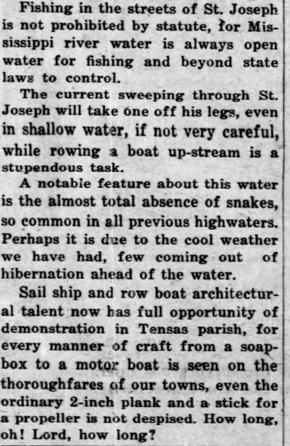
By May 13, the Tensas Gazette reported that water in St. Joseph was of varying levels: "the closer properties approach the levee the less depth, and the further out the gravel road the deeper the water." [9] The paper noted that the "river has fallen possibly four feet at St. Joseph and the levee has been used as parking place for a number of automobiles, possibly every garage in town being under water." [10] The paper also reported that floodwaters had entered several homes in the Black community, where "houses were built low and in low spots but the homes of few white people have been entered." [11]
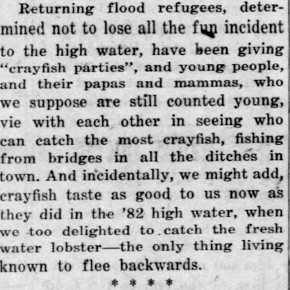
In late May, the floodwaters had begun to recede. By June 3, the Union Sunday School reopened after several weeks of closure "with very good attendance" and plans for a thanksgiving service at the end of June. [12]
[1] Betty Jo Hazlip Harris, "The 1927 Flood in Northeast Louisiana," (master's thesis, Northeast Louisiana University, 1994), 46.
[2] Ibid.
[3] Ibid.
[4] "The Overflow," Tensas Gazette (Saint Joseph, Louisiana), May 6, 1927, p. 2.
[5] Harris, "The 1927 Flood in Northeast Louisiana," 73.
[6] Ibid.
[7] Ibid., 74-75.
[8] Ibid., 75.
[9] "The Water," Tensas Gazette (Saint Joseph, Louisiana), May 13, 1927, p. 2.
[10] Ibid.
[11] Ibid.
[12] Tensas Gazette (Saint Joseph, Louisiana), June 3, 1927, p. 3.
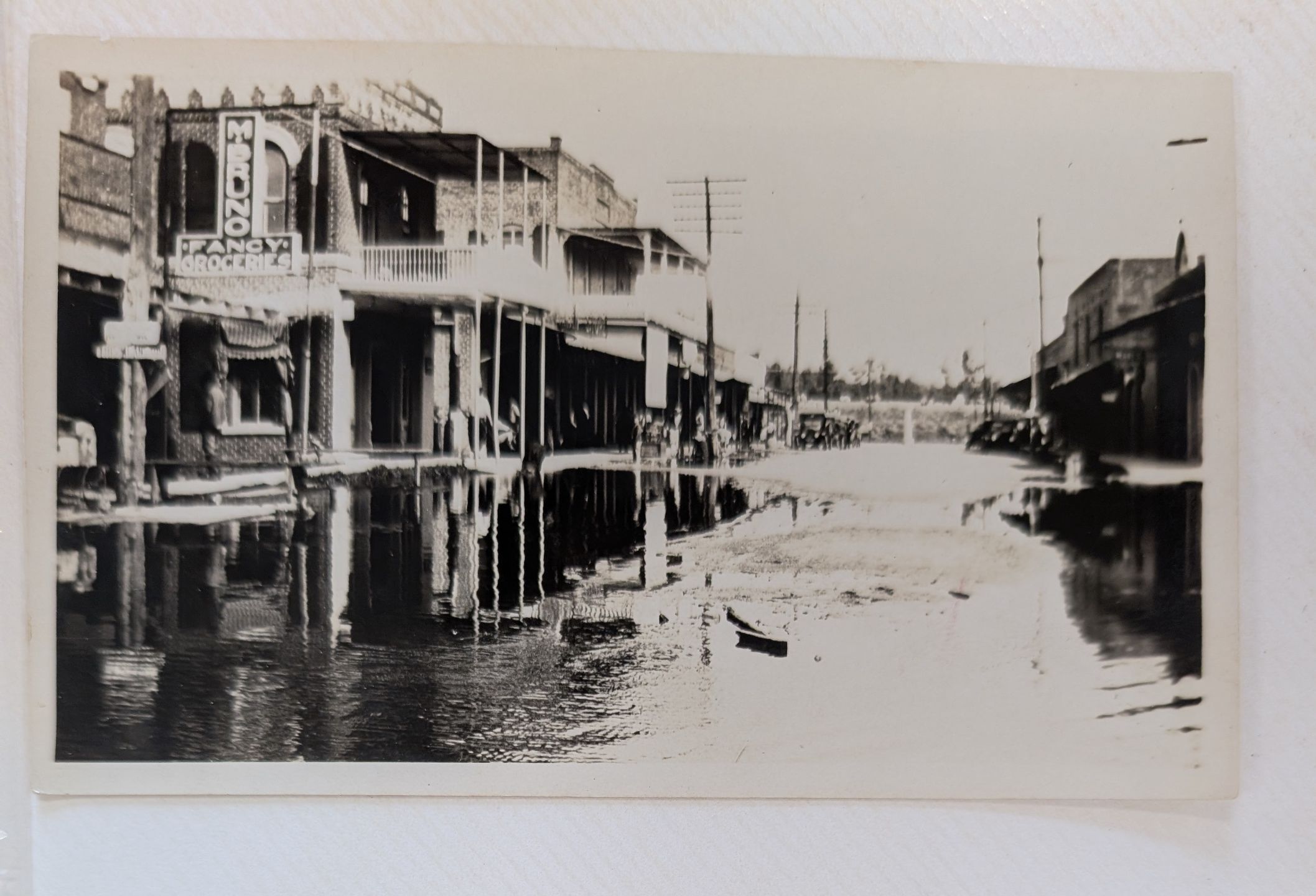
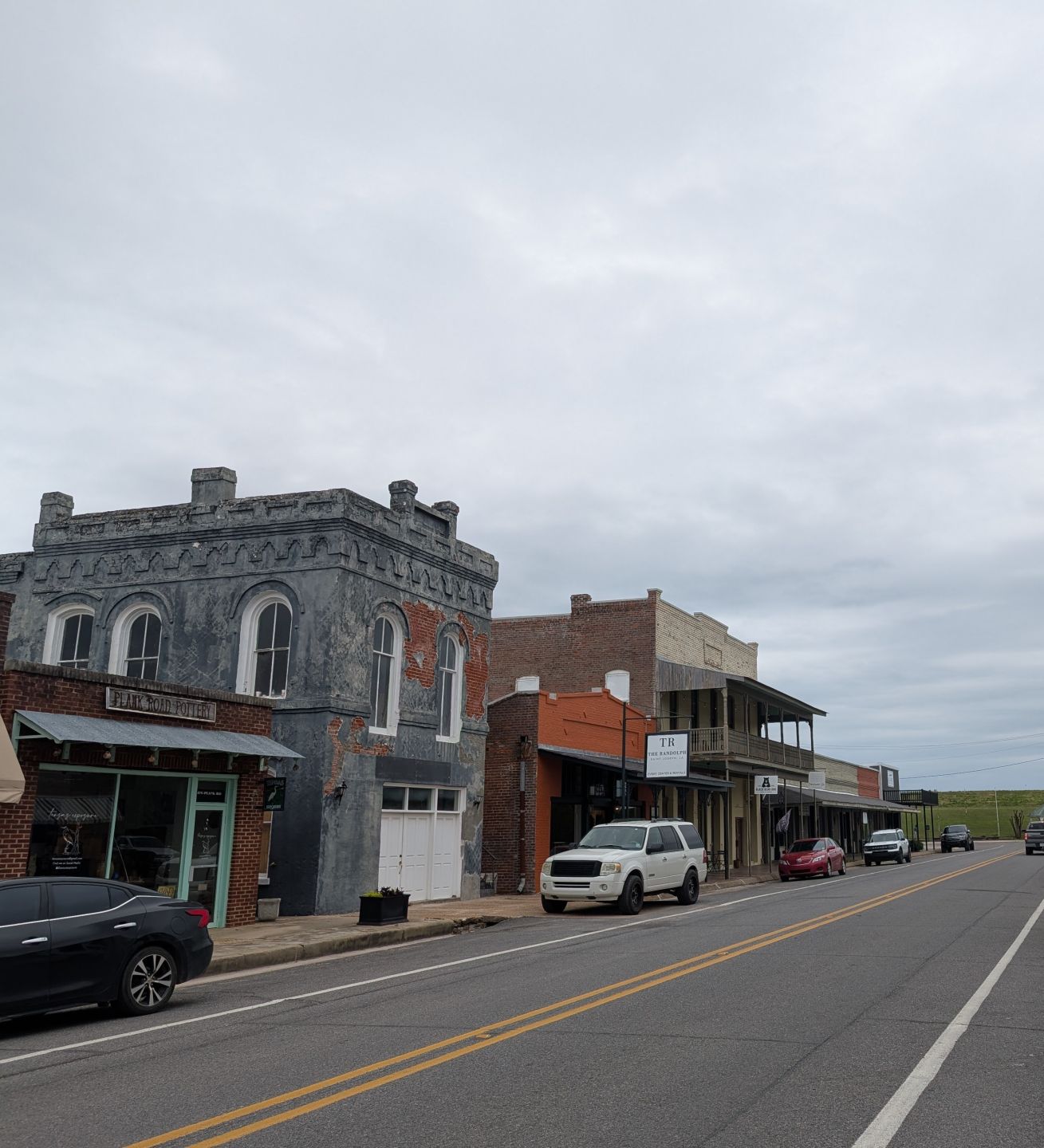
Top: Photo from 1927 Flood Collection, Tensas Parish Museum. The back of the photo reads: "showing how far up the water came." It was taken on what is now Plank Road looking east to the levee.
Bottom: Photo of same location taken by Project Manager in May 2026.
Above: Clippings from the local newspaper discuss fishing in the aftermath of the floodwaters.
Left: "The Water," Tensas Gazette (Saint Joseph, Louisiana), May 13, 1927, p. 2.
Right: Tensas Gazette (Saint Joseph, Louisiana), June 3, 1927, p. 3.
Timeline and Recollections of the 1927 Flood in the Bayou Teche
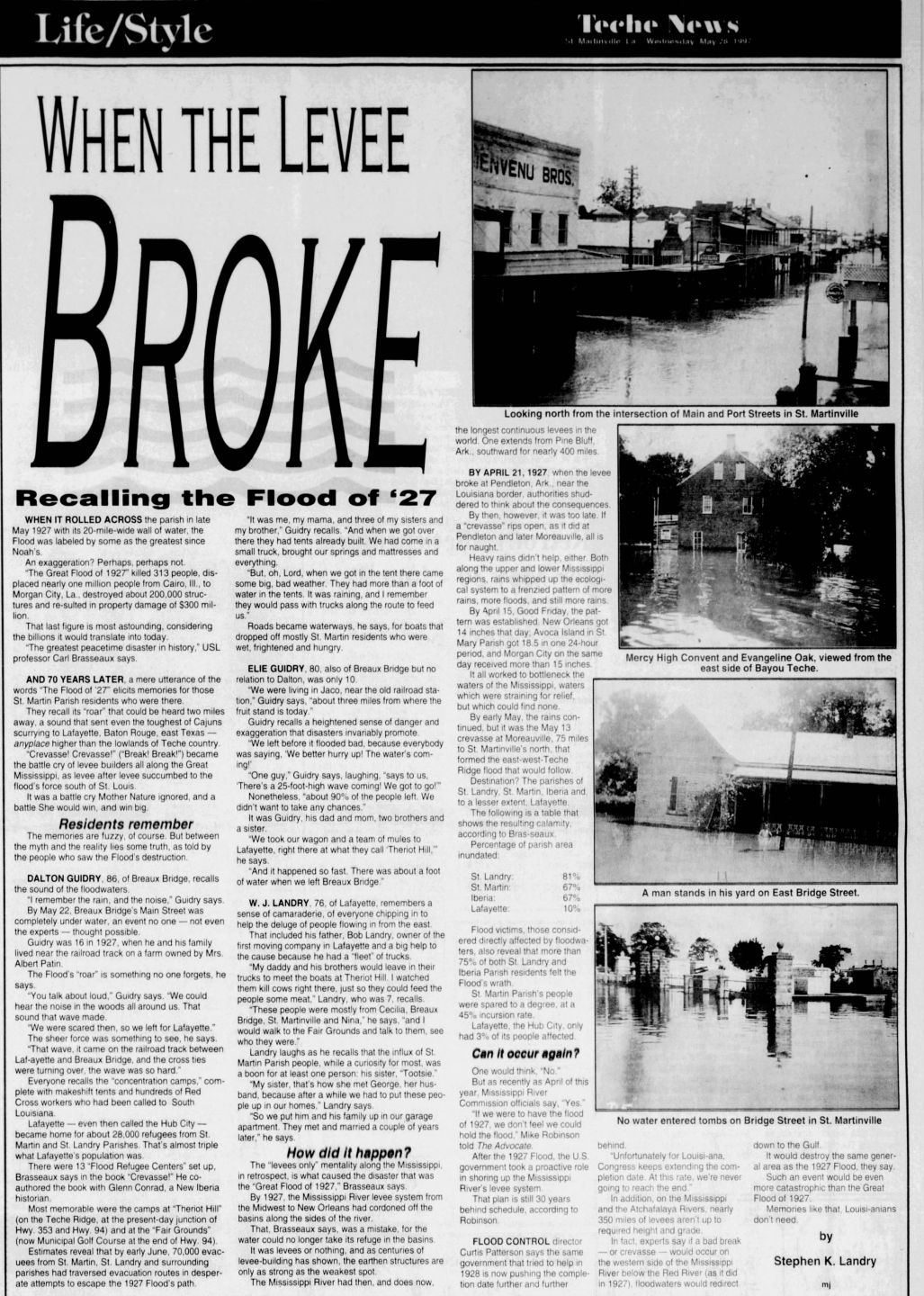
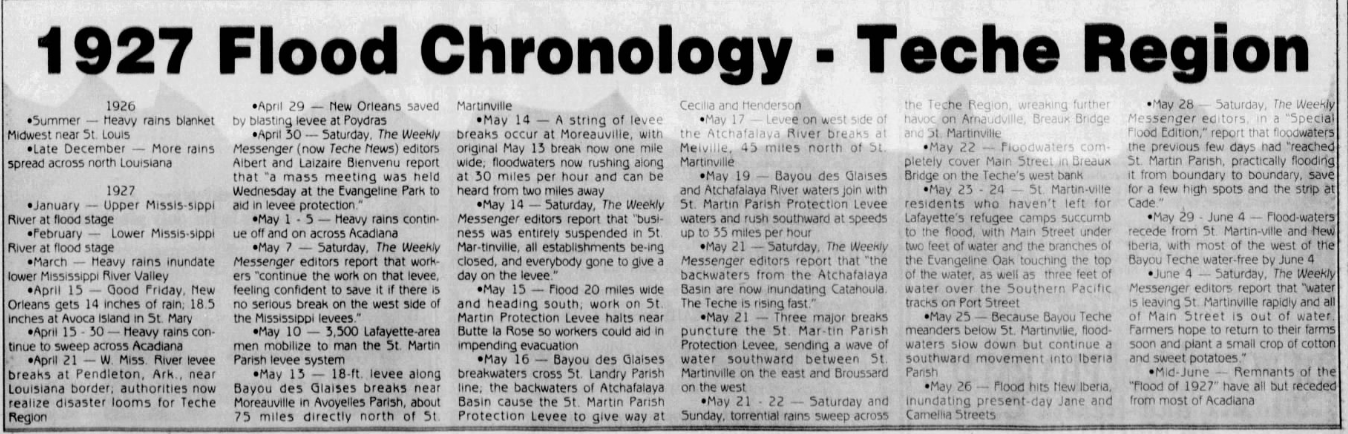
Below is a page from a May 28, 1997, issue (p. 15) of Teche News in St. Martinville, Louisiana, that provides recollections, photos, and a chronology of the Great Flood and its impact on the Teche region.
Source: Newspapers.com
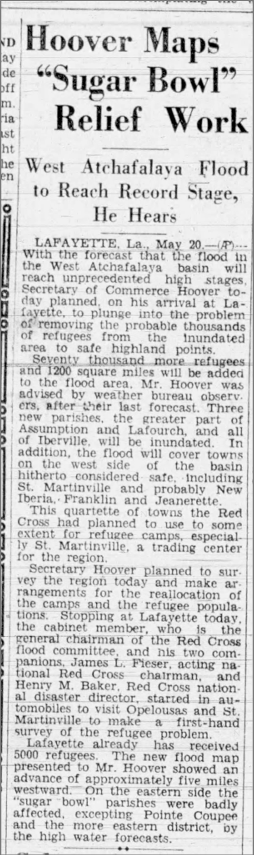
Herbert Hoover visits Lafayette, Louisiana (May 1927)
Above: "Hoover Maps 'Sugar Bowl' Relief Work," New Orleans States-Item (New Orleans, Louisiana), May 20, 1927, p. 10.
Archive/Collections Spotlight: "The 1927 Flood" - Butler Center for Arkansas Studies, Central Arkansas Library System
The Great Flood Project highlights existing archives and collections focused on the 1927 flood. "The 1927 Flood" is a curated digital collection created by the CALS Butler Center for Arkansas Studies.
The project details the devastating impact of the flood on the state of Arkansas and provides a timeline of events related to the disaster.
Learn more about the interactive project and corresponding entry in the Encyclopedia of Arkansas here.
Get Involved with the Great Flood Project: Share your Family/Community's History and Stories
The Great Flood Project is building an archive that is robust and collaborative in nature, serving as a landing page where existing archives and individuals can share primary sources and historical artifacts related to the Great Flood that help to document and preserve this important history. Perhaps you have stories, oral histories, photos, or documents from your family’s personal collection. Please consider sharing them with the project!
Individuals, organizations, institutional archives, etc. who have existing exhibits and/or collections or plan to create an exhibit/collection can reach out to kmccullum@lthp.org if you are interested in being included in the Website archive.