If you're having trouble viewing this email, you cansee it online.
Founded in 1979, the Louisiana Trust for Historic Preservation advocates, promotes, & preserves historic places representing our diverse culture.
February 2026
Project Updates
Country Roads magazine recently featured The Great Flood Project and the installation of the inaugural historical marker in New Roads, Louisiana (Pointe Coupee Parish), in its February issue (see p. 8).
Various historical markers have been confirmed and are in progress in Louisiana for Avoyelles, St. Mary, Natchitoches, and Ouachita Parishes. Please reach out to kmccullum@lthp.org if you are interested in pursuing a marker for your community.
On March 10th at 6 p.m. CST, the Great Flood Project will be the first topic of the LTHP’s Preservation Liveseries, which is a new quarterly series exploring the dynamics of historic preservation in Louisiana. Learn more and register here.
If you are based in Louisiana and wish to participate in the Great Flood Centennial through public humanities programming, consider applying for a Louisiana Endowment for the Humanities (LEH) Rebirth grant! Learn more about what types of projects are eligible and how to apply here. You may also register for a Q&A session (for March 3 at 10 a.m. or March 12 at 2 p.m.). Applications are open from February 19th – April 16th.
Site Spotlight: The Bayou des Glaises Breaks Near Moreauville (Avoyelles Parish)
On May 13, 1927, the levee along Bayou des Glaises broke to the east of Moreauville. [1] The crevasse in the Big Bend section was 600 feet wide by 9 a.m. [2] Floodwaters surged through farmland at thirty miles an hour.[3] A newspaper in Alexandria, Louisiana, reported that a train left with supplies from Camp Beauregard to take to Red Cross refugee camps in Mansura and Marksville. The paper also reported that the levee was tied with “tarpaulins and cables to prevent its widening.” [4]According to a report from New Orleans, efforts had been sustained for more than a week prior to the break to “hold back the climbing waters which streamed down upon the Bayou des Glaises embankments from crevasses on the west bank of the main stream above Natchez and Vicksburg, fed by the flood waters from Arkansas, and by the overflow and backwaters of the Red river.” [5] In nearby Bordelonville, water “had flowed over the top of the eighteen-foot levee for several days” [6] at the time of the break near Moreauville. Its citizens fled for safety, and the workers who had tirelessly fought on the levee were too exhausted to continue their efforts. [7] On May 14, the Bayou des Glaises levee at Bordelonville broke, followed by the levees at Cottonport and Long Bridge. [8] The Moreauville crevasse grew to a mile wide, and the rush of water was so powerful that it could be heard from “two miles away.” [9]
You can learn more about the Bayou des Glaises Crevasse by engaging with the Interactive Map on the Great Flood Website here.
[1] Glenn R. Conrad and Carl A. Brasseaux, Crevasse! The 1927 Flood in Acadiana (The Center for Louisiana Studies: Lafayette, Louisiana, 1994), p. 24.
[2] "Moreauville Levee on Big Bend Breaks, Flooding Big Area," The Town Talk (Alexandria, Louisiana), May 13, 1927, p. 1.
[3] Conrad and Brasseaux, 24.
[4] "Moreauville Levee on Big Bend Breaks."
[5] "Water Invades Fertile Section," The Town Talk (Alexandria, Louisiana), May 13, 1927, p. 1.
[6] Conrad and Brasseaux, 24.
[7] "Bordelonville Expects Break at any Moment," The Town Talk (Alexandria, Louisiana), May 13, 1927, p. 1.
[8] Conrad and Brasseaux, 24.
[9] Ibid.
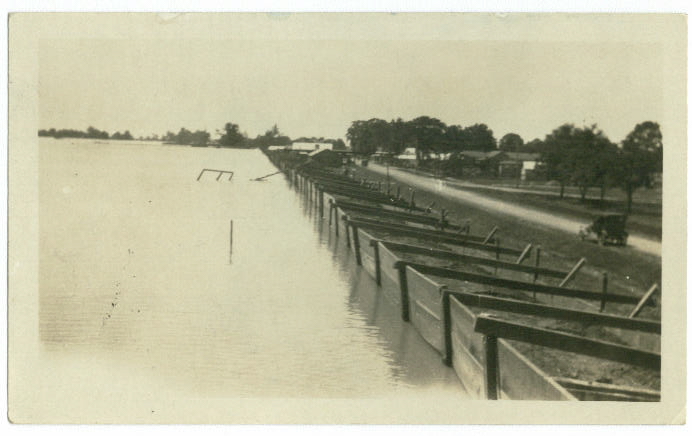
Above: "Govt levee between Moreauville and Bordelonville." Courtesy of U.S. Army Corps of Engineers, Mississippi Valley Division. Contributed by Brian Rentfro, Historian.
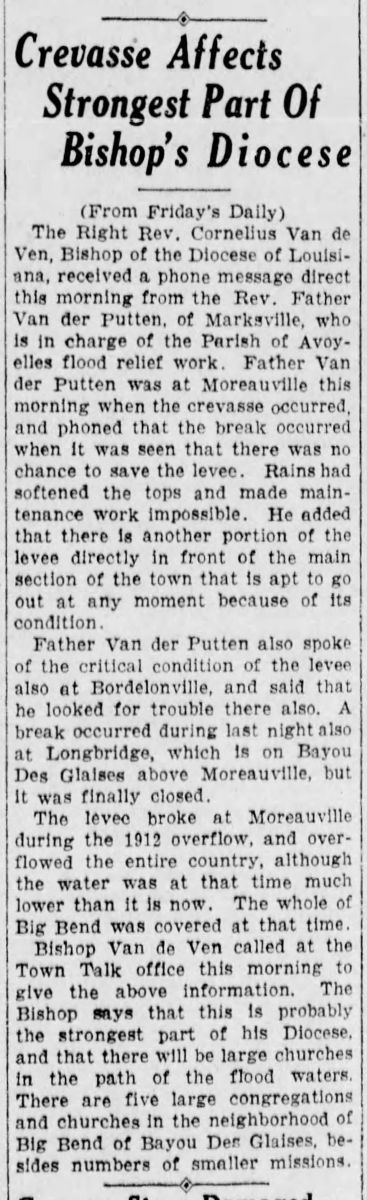
Above: A clipping from Weekly Town Talk, May 21, 1927, p. 5.
Black Histories and Places: The 1927 Flood and Mound Bayou, Mississippi
The historically Black community of Mound Bayou, Mississippi, was founded in 1887 by Isaiah T. Montgomery and Benjamin T. Green. It was established by and for formerly enslaved people who were determined to live freely in this “promised land.”[1] By the early 1900s, the town had an estimated 800 families and was surrounded by Black-owned farmland. [2] By the 1920s, Mound Bayou boasted dozens of Black-owned businesses and several mills. During the Great Flood of 1927, historically Black newspapers across the country reported on the heroic relief efforts by the town and its citizens. The Afro-American reported that then-Secretary of Commerce Herbert Hoover praised Mound Bayou, a town of 1,600 people, for “taking care of 1,100 flood victims” at the town’s own expense. [3] The same newspaper announced that, following a conference between Eugene Booze of Mound Bayou and Hoover in Memphis, a hospital was established near Cleveland, Mississippi, For Black flood refugees. [4]
The town is also a significant site of civil rights history—the Regional Council of Negro Leadership (RCNL), founded in 1951, operated through the early 1960s to fight for the civil and human rights of Black Mississippians.
[1] For more on historic Black towns and settlements, see Aallyah Wright, "The Fight to Stop the Erasure of Historic Black Towns," Capital B News, April 7, 2023, Historic Black Towns Are in Danger - Capital B News.
[2] Clyde Woods, Development Arrested: The Blues and Plantation Power in the Mississippi Delta (Verso Press, 2017), 85.
[3] "Hoover Praises Mound Bayou," The Afro-American (Baltimore, Maryland), May 21, 1927, p. 5.
[4] "Open Hospital in Flood Area," The Afro-American (Baltimore, Maryland), May 7, 1927, p. 6.
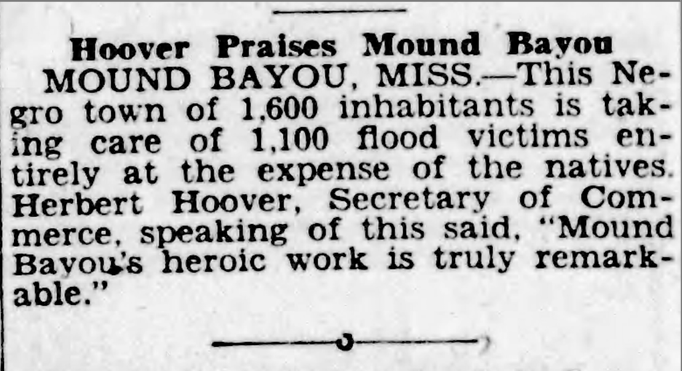
Above: "Hoover Praises Mound Bayou," The Afro-American (Baltimore, Maryland), May 21, 1927, p. 5.
Analyzing Sterling Allen Brown's Southern Road and Blues Poems
In 1932, while teaching at Howard University, Sterling Brown (professor, poet, folklorist) published his first book of poems as Southern Road. According to scholar Clyde Woods, Brown’s book of poetry represented “blues literature” because it highlighted Black working-class themes and folk traditions in the rural South. [1]His poems follow the blues form, and several touch upon floods. Various scholars have discussed Brown’s work as it relates to the blues and disaster. For example, Benjamin Johnson notes that the poem “Ma Rainey” describes the performance of the blues song “Back-Water Blues” (originally recorded by Bessie Smith). [2] These poems, which include "Children of the Mississippi” (1931), might be seen as a response to “the natural and political disaster that was the 1927 Mississippi flood.” [3] Meanwhile, David Anderson analyzes several of Brown’s poems and“sections” in Southern Road related to flood and disaster, and how Black sharecroppers had to constantly fight and adapt in order to survive. [4] Anderson argues that the poem “Memphis Blues” describes the self-determination of Black southerners to survive and “outlast power and oppression” in the segregated South as well as disaster and destruction. [5] Stephen E. Henderson describes how Brown’s “Riverbank Blues” emphasizes a “blues mood” through the description of a riverbank and an “undertone of threat and danger which one associates with blues about the forces of nature.” [6]
If the blues can be thought of as a form (and archive) of historic preservation (as previously discussed in the October 2025 newsletter), Southern Road might be considered a book of historic preservation—as Benjamin Johnson suggests (p. 116).
[1] Clyde Woods, Development Arrested: The Blues and Plantation Power in the Mississippi Delta (Verso Press, 2017), 18.
[2] Benjamin Johnson, "Modernity, Authenticity, and the Blues in Sterling Brown's Flood Poems," MELUS 42, no. 2 (2017), 115-135.
[3] Johnson, 116.
[4] David Anderson, "Sterling Brown's Southern Strategy: Poetry as Cultural Evolution in Southern Road," Callaloo 21, no. 4 (1998), 1023-1037.
[5] Anderson, 1027.
[6] Stephen E. Henderson, "The Heavy Blues of Sterling Brown: A Study of Craft and Tradition," Black American Literature Forum 14, no. 1 (1980), 32-44. The quote is on p. 32.
Get Involved with the Great Flood Project
There are several ways you can become involved with the Great Flood centennial. One way is to invest in a historical marker for your community that will share facts and stories about the 1927 flood in your area. The cost for fabrication and installation of the marker is approximately $10,000. We encourage communities to fundraise for the marker or seek sponsorship through a community business or corporation.
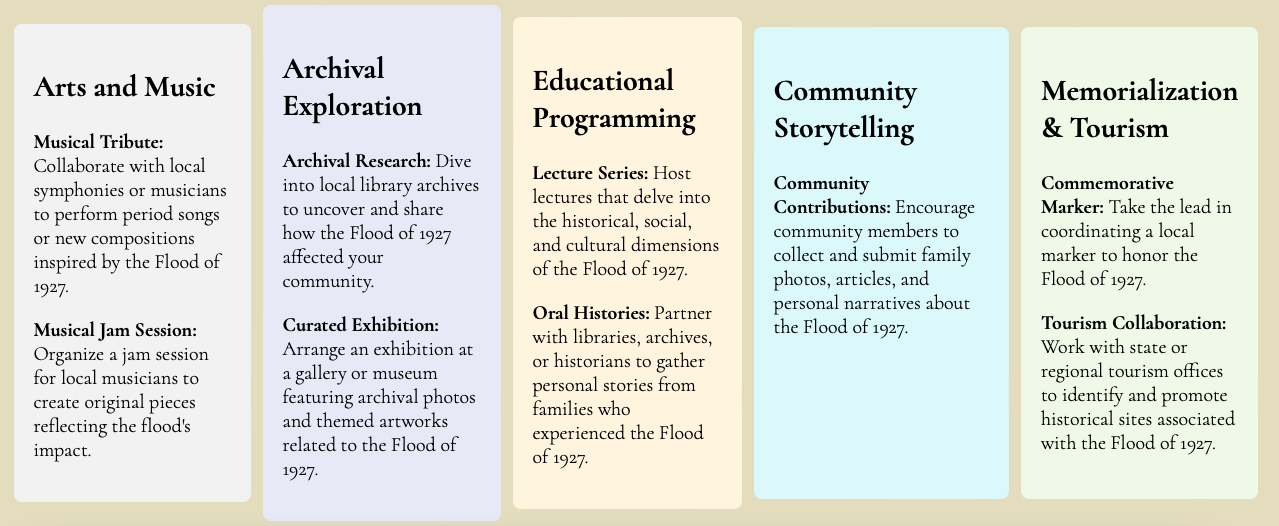
Another way to become part of the project is to plan/host an event, program, exhibit, etc. Be as creative as you would like! Here are examples of various programming you can plan:
Finally, you can share your family's or community’s stories. Do you have documents, photographs, or oral histories related to the flood?
If you want to reach out or become part of the Great Flood centennial program, please email kmccullum@lthp.org. If you haven’t already, consider becoming a member of the Louisiana Trust for Historic Preservation and follow us on social media for updates.