If you're having trouble viewing this email, you cansee it online.
Founded in 1979, the Louisiana Trust for Historic Preservation advocates, promotes, & preserves historic places representing our diverse culture.
January 2026
Project Updates
We hope you and yours are staying safe and warm.
The Great Flood Project has been busy the first few weeks of 2026 making connections and having conversations related to programming and the historical marker program with communities across the greater Delta region.
If your community is interested in investing in a historical marker or wants to participate in the Great Flood Centennial through programming, please complete the“Community Interest Form”or reach out to 1927flood@lthp.org.
Interacting with the Website:
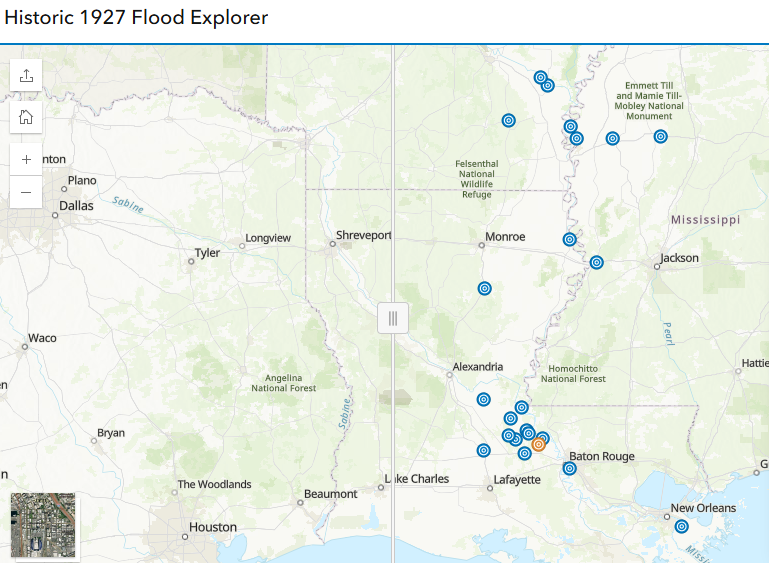
The "Historic 1927 Flood Explorer" is an interactive map found in the Archive. Here, you will find several layers that you can turn on/off depending on what you want to examine. Pictured below shows the map's "Visual Stories," with sites and accompanying stories (and primary sources!) across the Mississippi Valley such as Red Cross camps, crevasses, and more. New sites/stories are added weekly. Do you and/or your community have a story (or photos) to share? Let us know by reaching out via email or the Community Interest Form (linked above). As much as possible, we want this map to be a community-driven and collaborative effort. This is also where we will map historical markers as well as programming and events that communities and organizations are planning to commemorate the Centennial.
Mounds Landing Crevasse and the Mississippi Flood Blues
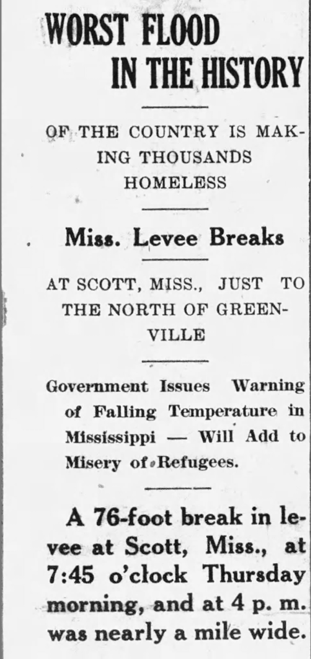
On the morning of April 21, 1927, the levee near Scott, Mississippi, gave out, creating what one newspaper called a 76-foot break. [1]Blues musician Big Bill Broonzy claimed Scott as his hometown. In 1937 he recorded "Terrible Flood Blues" and "Southern Flood Blues" following the flooding of the Mississippi and Ohio Rivers. [2] "Southern Flood Blues" spoke to the swift devastation of a monumental flood, describing how the water came through the door of the house and washed everything "down the street." This was the story that many people (and blues musicians) could tell/sing about the 1927 Flood and other environmental disasters. The storyteller/singer is stranded without help from rescue boats and without food to feed their family. The song documents a history about how the disaster disproportionately impacted poor Black southerners in the Delta. The sharecropping system was prevalent in the Mississippi Delta, and many Black agricultural workers were displaced by the 1927 Flood. According to the Mississippi Blues Trail marker at Scott, the "first structures destroyed included the cotton sharecroppers' tenant shacks that stood here on the property of Delta and Pine Land Company." [3]
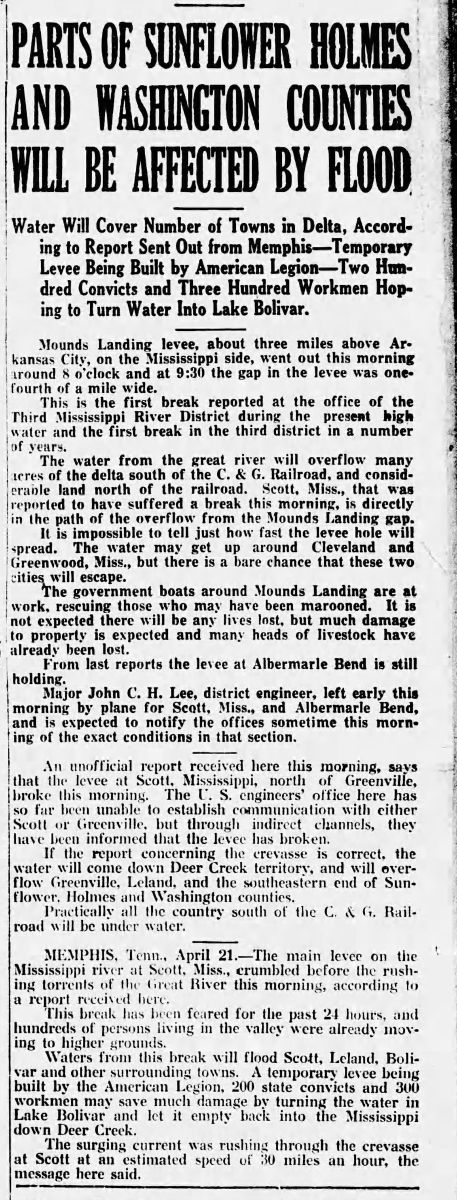
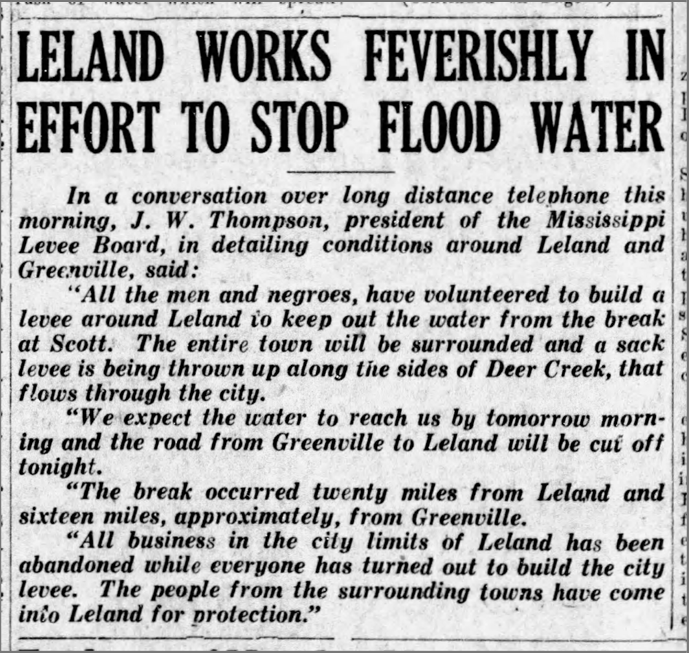
The Mounds Landing Crevasse inundated more than one million acres in the Mississippi Delta and displaced thousands of people. The levee breach was about 18 miles north of Greenville, Mississippi, and about 20 miles from Leland, Mississippi. [4] At the time of the break, newspapers reported on local efforts to prevent flooding. The Vicksburg Post noted that the American Legion, 200 convicted laborers, and 300 "workmen" were constructing a temporary levee that would turn "the water in Lake Bolivar and let it empty back into the Mississippi [River] down Deer Creek." [5]
The Mounds Landing Crevasse was considered the first major levee break during the 1927 Flood.
You can learn more about the Mounds Landing Crevasse by engaging with the Interactive Map on the Great Flood Website here.
Left: The Vicksburg Post (Vicksburg, Mississippi), April 21, 1927, p. 1.
Right: The Winona Times (Winona, Mississippi), April 22, 1927, p. 1.
Above: The Clarksdale Press Register (Clarksdale, Mississippi), April 21, 1927, p. 1.
[1]The Winona Times (Winona, Mississippi), April 22, 1927, p. 1.
[2] "MS River Blues - Scott," Mississippi Blues Trail.
[3] Ibid.
[4] The Clarksdale Press Register (Clarksdale, Mississippi), April 21, 1927, p. 1.
[5]The Vicksburg Post (Vicksburg, Mississippi), April 21, 1927, p. 1.
Stories about Flood Relief through Newspapers (and a Note on Primary Sources through a Critical Historian's Perspective)
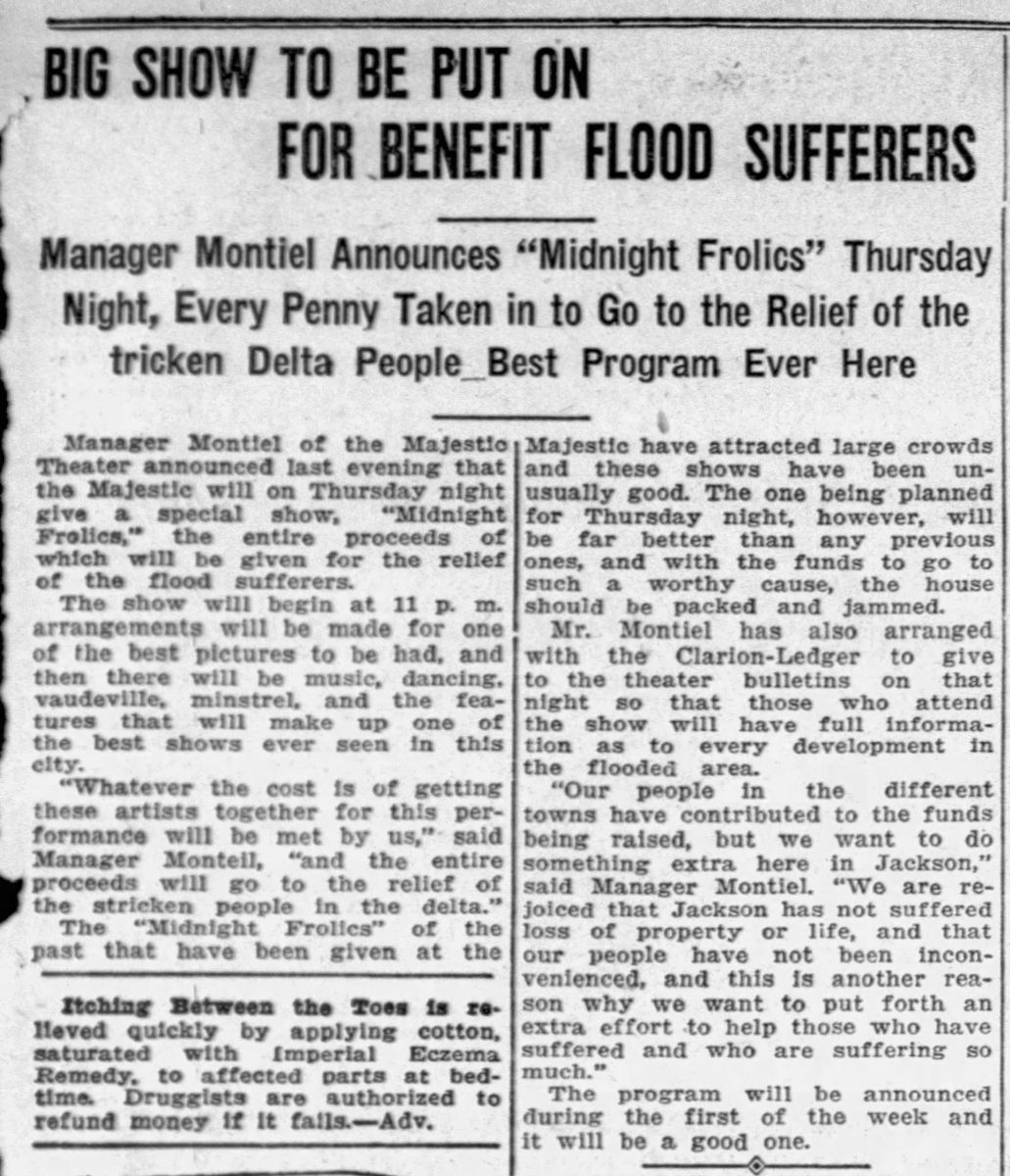
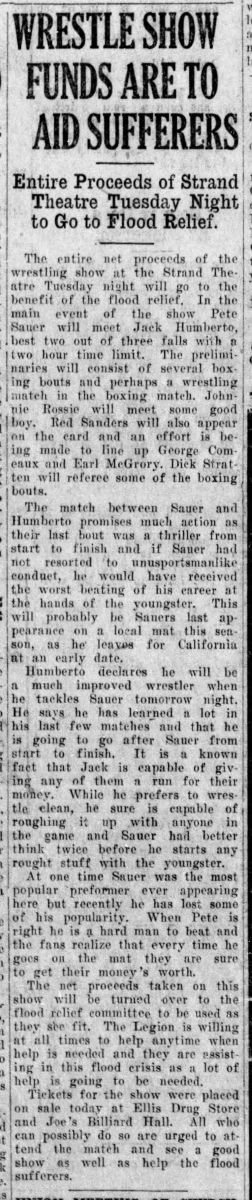
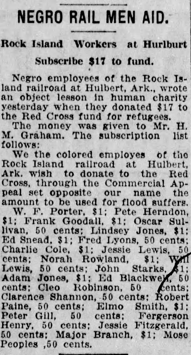
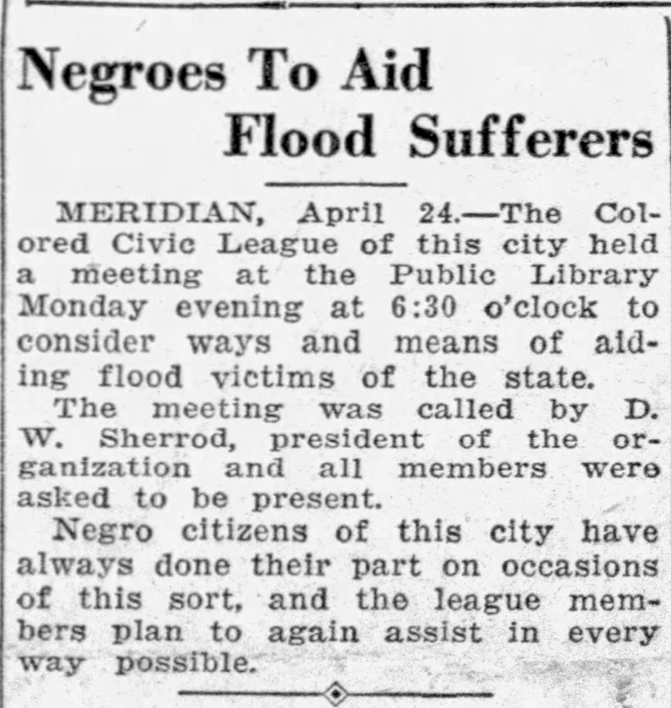
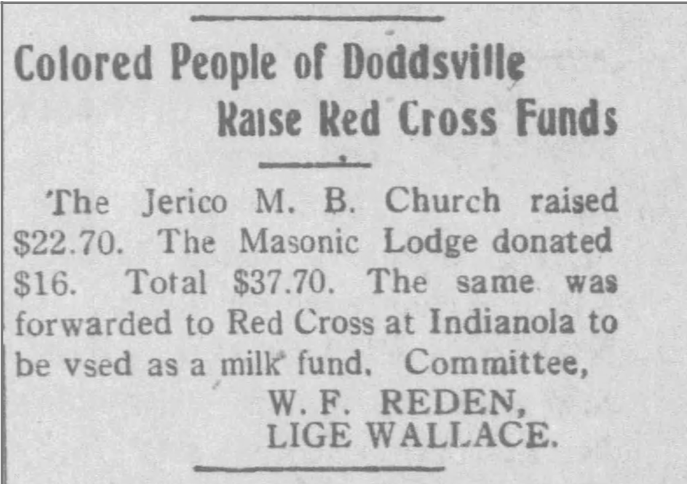
Newspapers across the country regularly reported on the 1927 Flood and urged the public to donate to relief efforts and the Red Cross. [1] The larger local southern newspapers (led by white publishers) featured write-ups on benefit shows and performances, particularly in communities that were not--or had not yet been--significantly inundated by floodwaters. They also included clippings detailing accounts of how Black laborers, civic organizations, and churches contributed to flood relief. These clippings were typically brief, with headlines that included the terms "Negro" or "Colored," which were terms widely used during the Jim Crow era.
In The Flood Year 1927: A Cultural History (2017), Susan Scott Parrish describes how, during the Great Flood, the medium of newspapers crossed regional and racial boundaries (particularly due to wire services and the Associated Press). For example, stories from "local" newspapers could be featured in a west coast newspaper, while a feature from a northern newspaper could be reprinted in a southern paper. [2] Meanwhile, Black publications such as the Chicago Defender distributed to readers across the country through a network of railroad porters. [3]
Examining primary sources such as newspapers requires critically interrogating them--doing so helps to provide a critical understanding of the historical context in which they were written. These historical newspapers have become part of an "archive" of historical/public memory. Archives are not neutral; there are omissions and silences. Choices are made as to which stories and histories are included, as well as how they are documented/preserved.
In Backwater Blues: The Mississippi Flood of 1927 in the African American Imagination (2014), Richard M. Mizelle, Jr., notes that "traditional archives obscure more than they reveal about black social realities during the 1927 flood." [4] In fact, many Black newspapers such as the Defender, Washington Bee, and Pittsburgh Courierchallenged the coverage of mainstream white newspapers, highlighting accounts of racial discrimination in refugee camps and in flood relief. [5] Similar to the blues, Black newspapers are an important part of the archive that tell a fuller history of the 1927 Flood and its legacy (These newspapers will be explored in further detail in a future newsletter).
[1] Susan Scott Parrish, The Flood Year 1927: A Cultural History (Princeton University Press, 2017), p. 68.
[2] Susan Scott Parrish, The Flood Year 1927: A Cultural History (Princeton University Press, 2017), p. 70.
[3] Ibid.
[4] Richard M. Mizelle, Jr., Backwater Blues: The Mississippi Flood of 1927 in the African American Imagination (University of Minnesota Press, 2014).
[5] Richard M. Mizelle, Jr., Backwater Blues, p. 77-78.
Above: Clarion-Ledger (Jackson, Mississippi), April 25, 1927, p. 3.
Above: The Clarksdale Press Register (Clarksdale, Mississippi), April 25, 1927, p. 4.
Left: The Commercial Appeal (Memphis, Tennessee), May 3, 1927, p. 4.
Right: Clarion-Ledger (Jackson, Mississippi), April 25, 1927, p. 1.
Above: The Enterprise-Tocsin (Indianola, Mississippi), May 12, 1927, p. 3.
Get Involved with the Great Flood Project
There are several ways you can become involved with the Great Flood centennial. One way is to invest in a historical marker for your community that will share facts and stories about the 1927 flood in your area. The cost for fabrication and installation of the marker is approximately $10,000. We encourage communities to fundraise for the marker or seek sponsorship through a community business or corporation.
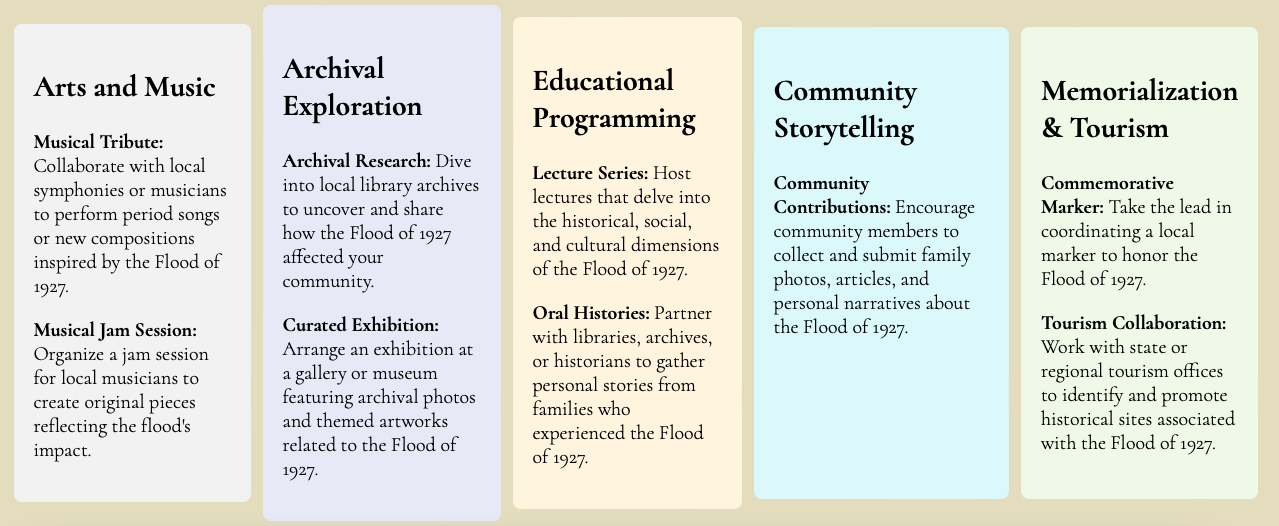
Another way to become part of the project is to plan/host an event, program, exhibit, etc. Be as creative as you would like! Here are examples of various programming you can plan:
Finally, you can share your family's or community’s stories. Do you have documents, photographs, or oral histories related to the flood?
If you want to reach out or become part of the Great Flood centennial program, please email kmccullum@lthp.org. If you haven’t already, consider becoming a member of the Louisiana Trust for Historic Preservation and follow us on social media for updates.
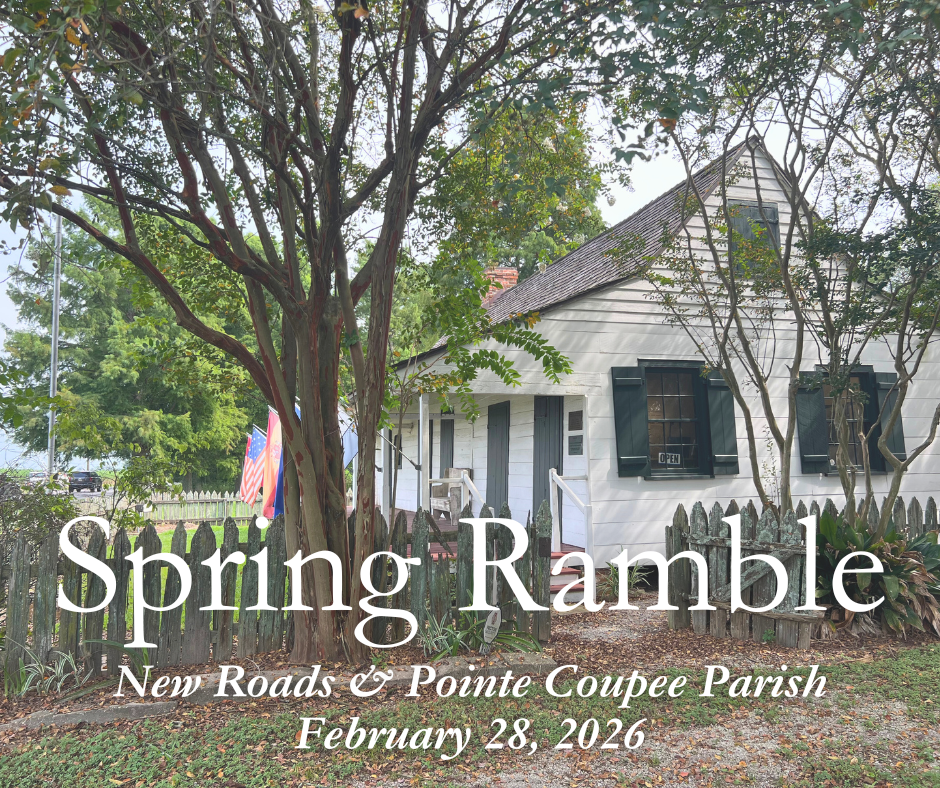
Join the LTHP for our Spring Ramble!
Journey with us to New Roads & Pointe Coupee Parish as we tour a dozen+ sites of cultural & architectural significance, including the St. Augustine Catholic Church, Bonnie Glen Plantation, Mt. Zion Riverlake Church, the Jacques Dupre House, and more.
Tickets are $50 for LTHP members, $65 for potential members, & $25 for students/teachers & include a boxed lunch when registering by the deadline of February 23 at 3:00 PM (registrations received after this date will be "tour only" & are not guaranteed a lunch).